Showing posts with label NCCPA. Show all posts

Friday, December 12, 2014

Certificates of Added Qualification (CAQ) Exams for Physician Assistants

Specialty Certificates of Added Qualifications (CAQ) Exams

CAQ exams for physician assistants are utilized for one purpose: to receive recognition for having obtained advanced clinical training and skills in your specialty. Since September of 2011, these exams have been given by the NCCPA just like the PANCE, and awarded to those who perform exceptionally. The CAQ emphasizes that PAs are grounded first in generalist medicine and then pursue additional qualifications in specialites. It serves as excellent documentation of knowledge, training, and experience in specialty practice. It also helps to avoid the confusion of any new PA “certification” program or any new specialty certification designation, as this credential is achieved in addition to the PA-C. According to Janet Lanthrop, old CEO of NCCPA, there were two desires in producing this exam: to have documentation to show hiring physicians that PAs were knowledgeable in specialty areas and to give hiring physicians assurance that the PA had experience in the specialty to come in at a certain level of acuity than your typical newly hired PA.

Wednesday, April 16, 2014

Continuing Medical Education (CME) for Physician Assistants

Continuing Medical Education (CME) for Physician Assistants
After you have finished the PANCE and thought you were all done with the NCCPA, you were wrong! So wrong! Continuing medical education credits are the next place they have come to steal your money, right before the next NCCPA exam, the PANRE. The six areas of PA competencies these CME credits evaluate are: medical knowledge, interpersonal and communication skills, patient care, professionalism, practice-based learning and improvement, and systems-based practice.


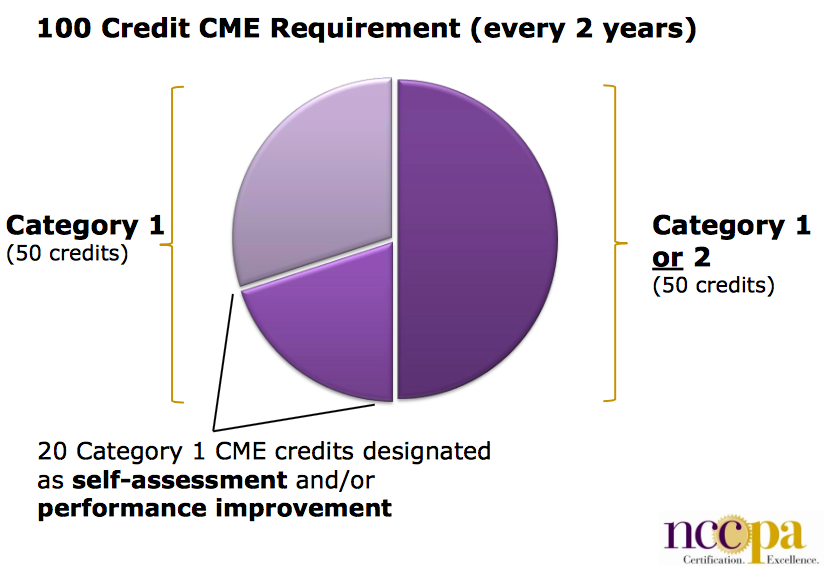
  • PAs must log 100 CME credit hours (with a $130 certification fee) every two years to maintain their national certification, per AAPA’s requirements.
  • Your CME earning and logging window is May 1st of the year your current certification was issued through December 31 of the certification expiration year.
    • If you have met your requirements for your current CME cycle, you can begin earning and logging credits for the next cycle on May 1st during the certification expiration year of your current cycle.
  • Additionally, each state may have their own specific CME requirements, which you can check here.
  • Of the 100 CME credits you must earn and log
    • At least 50 must be Category 1 CME
    • The remaining 50 credits can be Category 1, Category 2 or a combination of both.
  • CME can be classified as a Certification Program, Category 1 or Category 2.


Screen Shot 2014-12-11 at 2.43.32 PM.png


Category 1 CME

Wednesday, January 22, 2014

New Certification Process for PAs

New Certification Process for PAs 

It's a new year, and whether fortunately, or unfortunately (i'll let you make that opinion yourself), there is a new certification process in 2014 for physician assistants. The National Commission on Certification of Physician Assistants (NCCPA) originally instituted the recertification exam for PAs in the 1980s, and this is the first major change since then. The new process includes a switch from a 6 year recertification process to a 10 year certification process. These changes are taking place for three groups of PAs:

  1. People certified for the first time (probably YOU, students reading this blog)
  2. People certified AGAIN after a lapse in certification (have you left practice for a few years due to medical leave of absence? possibly a leave of absence for childcare reasons?)
  3. People who complete a 6-year certification maintenance cycle in 2014
If you don't fit any of these categories, you will transition to the 10 year cycle as you complete the 6-year certification maintenance process already in progress. 

What's the Same?

  • Still required to earn/log 100 CME credits during every "2-year" CME log cycle
    • Those 100 CME credits must include 50+ Category 1 credits
  • PANRE exam still at the end of the process

New Updates