Showing posts with label list. Show all posts

Friday, January 30, 2015

Gastroenterology List of Most Commons for Physician Assistant Students

Esophageal adenocarcinoma is the fastest growing cancer in the United States. In total, it affects about 1.5 million people per year worldwide and 38,000 in the US alone. There has been a 6-fold increase in the last 3 decades, accounting for 60% of esophageal cancers. This is one puppy you don’t want to mess with; don’t even get me started on colorectal cancer!

Gastroenterology accounts for 10% of the PANCE, so make sure you pay attention during this part of your didactic phase! Knowing that, you had better take a step into gastroenterology with your thinking cap on ready to learn about new disease and therapy that can affect the way you provide care everyday.

Most Commons in Gastroenterology
  • Heartburn (pyrosis) - most common symptom of esophageal disease
  • GERD (Gastroesophageal reflux disease) - most common disorder of the esophagus
  • Ulcerative Colitis - most commonly affects young adults in 2nd and 3rd decade of life, but 2nd peak in 7th decade
    • Most common in N. America, England, N. Europe, and Australia
    • More common in industrialized countries
    • More common in higher socioeconomic status
    • Important: Ulcerative colitis increases the risk of colorectal cancer
  • Crohn’s Disease - most common between 15-30 years of age, though can present at any age
    • More common in industrialized countries
    • More common in higher economic status
    • Most common in N. America, England, N. Europe, and Australia
    • Skip areas common: The most common distribution pattern of Crohn’s disease is ileocecal, which involves the distal portion of the small intestine (terminal ileum) and the proximal large bowel (40% of patients)
  • Most common skin lesions in IBD: pyoderma gangrenosum and erythema nodosum

Monday, November 17, 2014

Pulmonology List of Most Commons for Physician Assistant Students

This topic deserves an introduction. Why? Because it is Lung Cancer Awareness Month. How many of you have ever heard of Lung Cancer Awareness Month? Exactly. That’s probably because Breast Cancer Awareness Month probably stole its light in October. Unfortunately, breast cancer does not cause the most mortality in the United States, lung cancer does; that goes for men and for women. Why is this? Probably because there is not a unified and inexpensive diagnostic screening method for lung cancer as there is for breast cancer. Lung cancer causes almost double the number of deaths per year as breast, colon/rectal, and prostate cancers. Nonsmokers living with smokers have more than a 30% increased risk for developing lung cancer, regardless of whether or not the smoker is physically smoking around the nonsmoker or not. A diet rich in fruits and vegetables may protect against the development of lung cancer in smokers. However, high dose supplements of beta-carotene (also found in carrots) has been shown to increase the risk for lung cancer and is not recommended. So there you go. I have increased your knowledge about lung cancer in a matter of a few minutes. Hopefully now you will remember that every november is Lung Cancer Awareness Month and that you will remember to include lung cancer in your differential and to screen folks for it when necessary.


Most Commons in Pulmonology
  • Cough - Most common complaint seen in outpatient setting
  • Dyspnea (difficulty breathing) - common complain at emergency department
  • COPD - most common respiratory disease; 3rd leading cause of death in US
    • More prevalent in males
  • Most common cause of COPD - cigarette smoking
  • Most common bacterial pathogens in COPD are: Streptococcus pneumoniae, Haemophilus influenzae, and Moraxella catarrhalis
  • Asthma - most common in children
    • More common in male children
    • Prevalence changes to adult women after puberty
    • Most common in Caucasians
    • Most are categorized as moderate persistent
    • More common in obese individuals
  • Most common Interstitial Lung Diseases
    • (1) Usual Interstitial Pneumonia (idiopathic pulmonary fibrosis) - idiopathic interstitial pneumonia (IIP)
    • (2) Sarcoidosis - idiopathic, granulomatous
    • (3) Hypersensitivity Pneumonitis (HP) - known cause, granulomatous

Sunday, October 19, 2014

Cardiology List of Most Commons for Physician Assistant Students


Dear Readers,

Below are the most commons in cardiology that I’ve put together from this block. I’m sure once I enter rotations I will be adding many more. Can I just say that one of my biggest pet-peeves right now is the incorrect pronunciation of medical terms? For example, angina. This word has been produced in two ways by various professors, but there must be a correct way to pronounce it, so naturally, I looked it up. “An-jen-uh” is the correct pronunciation, while “an-jine-ah” is colloquially used, but incorrect.

Cardiology Most Commons
  • Most common pathologic process of the pericardium - Pericarditis
    • Most common etiology of Acute Pericarditis - coxsackievirus A and B
  • Most common cause of death in the U.S. - Coronary Artery Disease (CAD)
    • Coronary microcirculation disease more common in women - this is why CAD affects more women than men annually
    • Exercise electrocardiography less accurate in women
    • More women die each year of CAD
  • Most common cause of sudden cardiac death: ventricular fibrillation
  • Most common cause of sudden cardiac death in young athletes: hypertrophic obstructive cardiomyopathy (HOCM)
  • Hypertension
    • More common in women as age increases
    • More common in men in young and middle aged people
    • More common in African Americans and lower socioeconomic groups
      • African Americans develop at earlier age compared to other races
    • Secondary HTN - more common in children
  • White coat HTN - affects more treated women than men
  • HTN is the SECOND most common cause of CKD

Monday, September 1, 2014

Dermatology List of Most Commons for Physician Assistant Students


Most PA programs teach in a systems-based style of learning with “block” style approaches to navigating through the mounds of medical factoids we must learn and know. It’s often talked about how PA students should start their own lists of “most commons” in medicine for each block or system in preparation for course examinations and the PANCE. It has come to my attention that this is most definitely the case. As such, I’ve decided to create a list of most commons for each block we cover, the first being Dermatology!

Most Commons in Dermatology:
  1. Most common treatment for keloids: triamcinolone acetonide (corticosteroid) in concentrations of 10-40 mg/mL at 4-6 week intervals
  2. Most common cutaneous cyst: epidermal inclusion cyst (EIC), also known as cutaneous cysts
  3. One of Top 3 Skin problems in children: verruca vulgaris
    1. Most common primary treatment: cryotherapy and salicylic acid (cure rate improved by combining both therapies)
  4. Human Papilloma Virus (HPV) is one of the most common STIs causing Condylomata Acuminate, also known as External Genital Warts (EGW)
  5. Most common type of psoriasis: Plaque Psoriasis (affects 80-90% of patients).
  6. Most common clinical pattern seen in Psoriatic Arthritis:
    1. Oligoarthritis - swelling and tenosynovitis of one/few hand joints.
  7. The “Butterfly Rash”
    1. Many facial rashes are described as malar or “butterfly” rashes
    2. Most commonly, they are either: seborrheic dermatitis or rosacea, NOT systemic lupus erythematosus (SLE)
  8. Most common dermatologic condition in infants: Diaper Rash (diaper candidiasis)

Wednesday, April 16, 2014

Continuing Medical Education (CME) for Physician Assistants

Continuing Medical Education (CME) for Physician Assistants
After you have finished the PANCE and thought you were all done with the NCCPA, you were wrong! So wrong! Continuing medical education credits are the next place they have come to steal your money, right before the next NCCPA exam, the PANRE. The six areas of PA competencies these CME credits evaluate are: medical knowledge, interpersonal and communication skills, patient care, professionalism, practice-based learning and improvement, and systems-based practice.


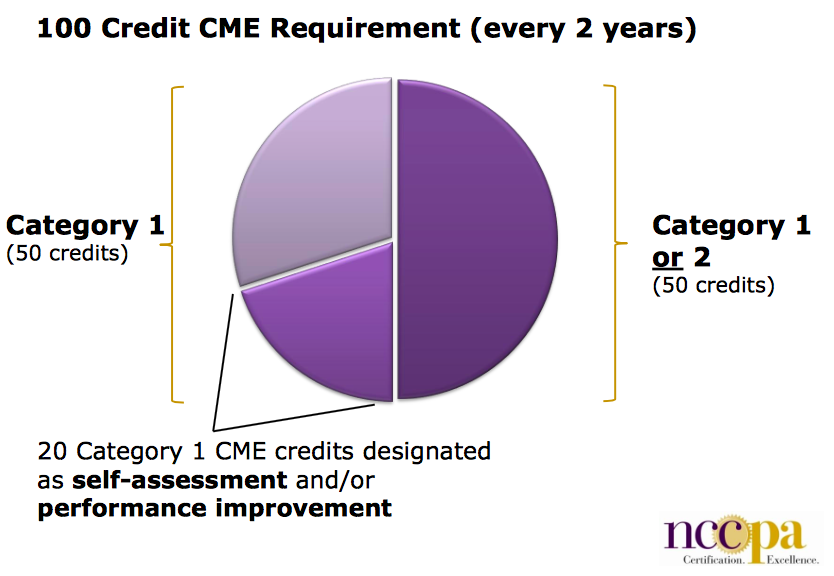
  • PAs must log 100 CME credit hours (with a $130 certification fee) every two years to maintain their national certification, per AAPA’s requirements.
  • Your CME earning and logging window is May 1st of the year your current certification was issued through December 31 of the certification expiration year.
    • If you have met your requirements for your current CME cycle, you can begin earning and logging credits for the next cycle on May 1st during the certification expiration year of your current cycle.
  • Additionally, each state may have their own specific CME requirements, which you can check here.
  • Of the 100 CME credits you must earn and log
    • At least 50 must be Category 1 CME
    • The remaining 50 credits can be Category 1, Category 2 or a combination of both.
  • CME can be classified as a Certification Program, Category 1 or Category 2.


Screen Shot 2014-12-11 at 2.43.32 PM.png


Category 1 CME

Monday, March 17, 2014

Postbaccalaureate and Master’s Programs for Physician Assistant School

Postbaccalaureate and Master’s Programs for PA School


Postbaccalaureate Programs (Non-Master's Degree)
If you’ve already applied to PA school or you are considering applying and your GPA is not competitive enough for admission, you might consider postbaccalaureate programs (“post-bacc” programs) or master level programs. These programs require an undergraduate degree as a prerequisite, but they are not always considered graduate education. Some programs are considered “continuing education” and can lead to a graduate degree, a certificate, or aid you in meeting the entrance requirements to a physician assistant program. Although mainly for premedical students, AAMC offers a search tool for postbaccalaureate programs. This can be a useful tool as many of the courses taken in premedical postbacc programs will be the same. Always ensure that the program you choose doesn’t have a requirement for MCAT scores and that the program isn’t solely for medical, dental, or vet school bound students.


You’ll want to ensure you choose the right program for yourself. Postbaccalaureate programs are broken into different focuses: career-changers, academic record-enhancers, groups underrepresented in medicine, economically or educationally disadvantaged students, and other. Career changer programs are geared to students who did not complete prerequisite requirements as undergraduates and are designed to provide preparation in the basic prerequisite sciences and complementary coursework and experiences. Academic enhancement programs are designed for students who have completed the prerequisite sciences but need to “enhance” and strengthen their science GPAs. The basic idea is to give students the opportunity to prove themselves by taking demanding science courses. These programs typically offer master’s degrees or certificates. Underrepresented in medicine means those racial and ethnic populations that are underrepresented in the medical profession relative to their numbers in the general population. Economically or educationally disadvantaged means those students who have endured financial hardship or with a learning disability who wish to pursue medical education. These last two programs, which generally fall under the heading of enhancement programs, are designed to support underrepresented students and increase the numbers of them who apply successfully to health professional schools.


Postbaccalaureate programs are designed to increase your knowledge of the sciences, and in doing so, can make your application much more competitive if you have a weak undergraduate GPA.