Showing posts with label infectious disease. Show all posts

Wednesday, August 10, 2016

Antibiotics for PAs - Part I

Antibiotics for Physician Assistants - Part I
Updated: 08/07/2016
  • Empiric therapy is defined as the initiation of treatment prior to firm diagnosis, and knowing the specific organism causing the infection
    • Started only after cultures have been obtained
    • Targets likely pathogens and must use local antibiogram
  • Broad spectrum means covering both gram positive and gram negative bacteria
  • Pharmacokinetics: what the body does to a drug
    • Absorption: described in terms of bioavailability (F)
      • 100% bioavailable drugs (PO = IV): Linezolid, Fluoroquinolones, Tetracyclines, Azithromycin, Metronidazole, Trimethoprim/Sulfamethoxazole (Bactrim), Rifampin
    • Distribution: affected by protein binding, blood flow, molecular size, lipophilicity, inflammation, and fluid status
    • Metabolism: occurs primarily in the liver via multiple mechanisms
      • Phase I: oxidation/reduction (CYP 450), hydrolysis
      • Phase II: glucuronidation, sulfonation, methylation, acetylation, glutathione
    • Elimination: primarily renal (glomerular filtration and tubular secretion)
      • Most antibiotics require dose adjustment for creatinine clearance (CrCl) <50 mL/min

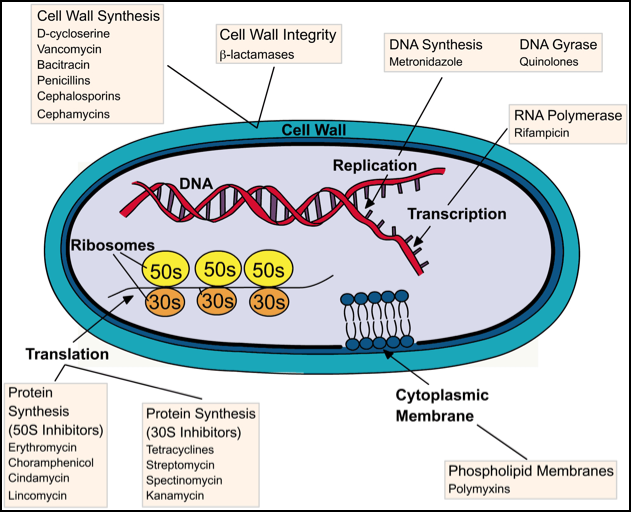
Screen Shot 2016-08-07 at 3.16.10 PM.png
Cell Wall Synthesis Inhibitors

Tuesday, March 29, 2016

Introduction to Medically Important Bacteria

Introduction to Medically Important Bacteria
Updated: 08/07/2016
Types of Therapy
  • Prophylactic Therapy – treatment initiated to prevent an infection that has not yet developed
    • Ex. Antibiotic “prophy” to prevent opportunistic bacterial infections
    • Ex. Antibiotics while on a trip to Mexico
    • Ex. Antibiotics before surgery or dental procedures to prevent bacterial endocarditis
  • Empiric Therapy
    • Empiric – relies solely on observation or practical experience.
    • Therapy initiated to treat serious infections until test results are available; or therapy for minor infections (URI’s, UTI’s) because causative organisms are predictable and their susceptibility to available antibiotics is known
  • Definitive Therapy
    • Start broad spectrum antibiotics before the culture and sensitivity results are reported. When they become reported, you know what will kill the bug in vitro and can tailor the therapy making it less broad and more definitive.
    • The hospital antibiogram can assist with empiric or definitive therapies.
  • Antibiogram
    • The cumulative results of hospital performed bacterial susceptibility testing organized into a summary table which may be used by clinicians, pharmacists, infection control personnel and microbiologists as a reference guide to community or hospital-specific resistance patterns.