Showing posts with label pulmonology. Show all posts

Sunday, February 7, 2016

Pulmonology Review for Rotation Exams

Pulmonology for Rotation Exams
Peak Expiratory Flow - use a peak flow meter
  • If <350 L/min, perform PFTs to screen for obstruction
Pulmonary Function Testing
  • FEV1: amount of air that can be forced out of the lungs in 1 second
    • Airway obstruction diagnosed by: normal/increased TLC with decreased FEV1
      • FEV1/FVC < 0.7
Disease
FEV1
FVC
FEV1/FVC
FEF25-75
FET
Peak Exp Flow
Obstructive
Decreased
<80%
Normal
<80%
Decreased
< 0.7
Decreased
<60%
Increased
Low
Restrictive
Normal or
Decreased
<80%
Decreased
<80%
Normal or Increased
0.7
Normal
>60%
Normal
Normal
Mixed
Decreased
<80%
Decreased
<80%
Decreased
< 0.7
Decreased or Normal
<60%
Increased or Normal

    • Tiffeneau index (FEV1/FVC x 100): % of FVC expired in one second
    • FET = Forced Expiratory Time
  • Pay Attention Here: The important thing to know about how to differentiate an obstructive vs. restrictive lung disease is based on their TLC, not the vital capacity, which will be decreased in obstructive lung diseases (this can be misleading).
Disease
TLC
FRC
TV
RV
VC
Obstructive
Increased
Increased
N
Increased
Decreased
Restrictive
Decreased
Decreased
N
Decreased
Decreased
  • Total Lung Capacity: volume of air in lungs after maximum inspiration
  • Functional Residual Capacity: volume of air in lungs after normal expiration
  • Residual Volume: volume of air in the lungs at maximal expiration
  • Tidal Volume: volume of air breathed in and out of lungs during quiet breathing
  • Vital Capacity: volume of air expelled from the lungs during a maximum expiration
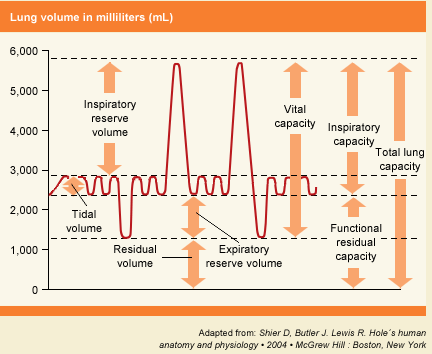
1221_lung_volume.gif

Monday, November 17, 2014

Pulmonology List of Most Commons for Physician Assistant Students

This topic deserves an introduction. Why? Because it is Lung Cancer Awareness Month. How many of you have ever heard of Lung Cancer Awareness Month? Exactly. That’s probably because Breast Cancer Awareness Month probably stole its light in October. Unfortunately, breast cancer does not cause the most mortality in the United States, lung cancer does; that goes for men and for women. Why is this? Probably because there is not a unified and inexpensive diagnostic screening method for lung cancer as there is for breast cancer. Lung cancer causes almost double the number of deaths per year as breast, colon/rectal, and prostate cancers. Nonsmokers living with smokers have more than a 30% increased risk for developing lung cancer, regardless of whether or not the smoker is physically smoking around the nonsmoker or not. A diet rich in fruits and vegetables may protect against the development of lung cancer in smokers. However, high dose supplements of beta-carotene (also found in carrots) has been shown to increase the risk for lung cancer and is not recommended. So there you go. I have increased your knowledge about lung cancer in a matter of a few minutes. Hopefully now you will remember that every november is Lung Cancer Awareness Month and that you will remember to include lung cancer in your differential and to screen folks for it when necessary.


Most Commons in Pulmonology
  • Cough - Most common complaint seen in outpatient setting
  • Dyspnea (difficulty breathing) - common complain at emergency department
  • COPD - most common respiratory disease; 3rd leading cause of death in US
    • More prevalent in males
  • Most common cause of COPD - cigarette smoking
  • Most common bacterial pathogens in COPD are: Streptococcus pneumoniae, Haemophilus influenzae, and Moraxella catarrhalis
  • Asthma - most common in children
    • More common in male children
    • Prevalence changes to adult women after puberty
    • Most common in Caucasians
    • Most are categorized as moderate persistent
    • More common in obese individuals
  • Most common Interstitial Lung Diseases
    • (1) Usual Interstitial Pneumonia (idiopathic pulmonary fibrosis) - idiopathic interstitial pneumonia (IIP)
    • (2) Sarcoidosis - idiopathic, granulomatous
    • (3) Hypersensitivity Pneumonitis (HP) - known cause, granulomatous