Monday, December 28, 2015

Fifth Semester at UT Southwestern

Fifth Semester at UTSW
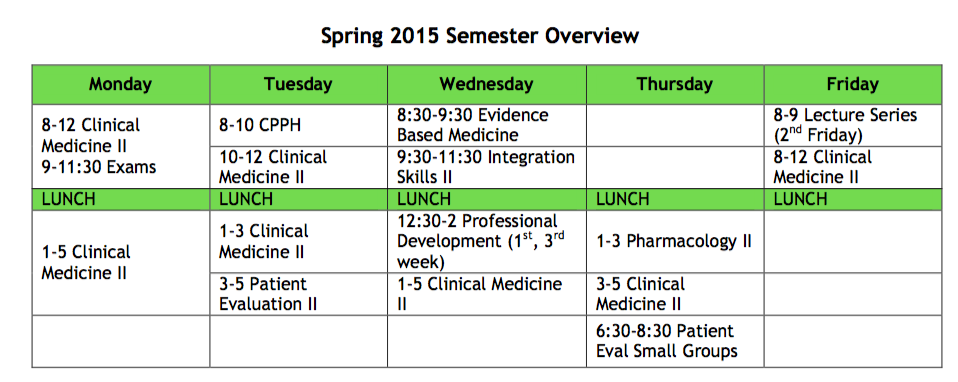
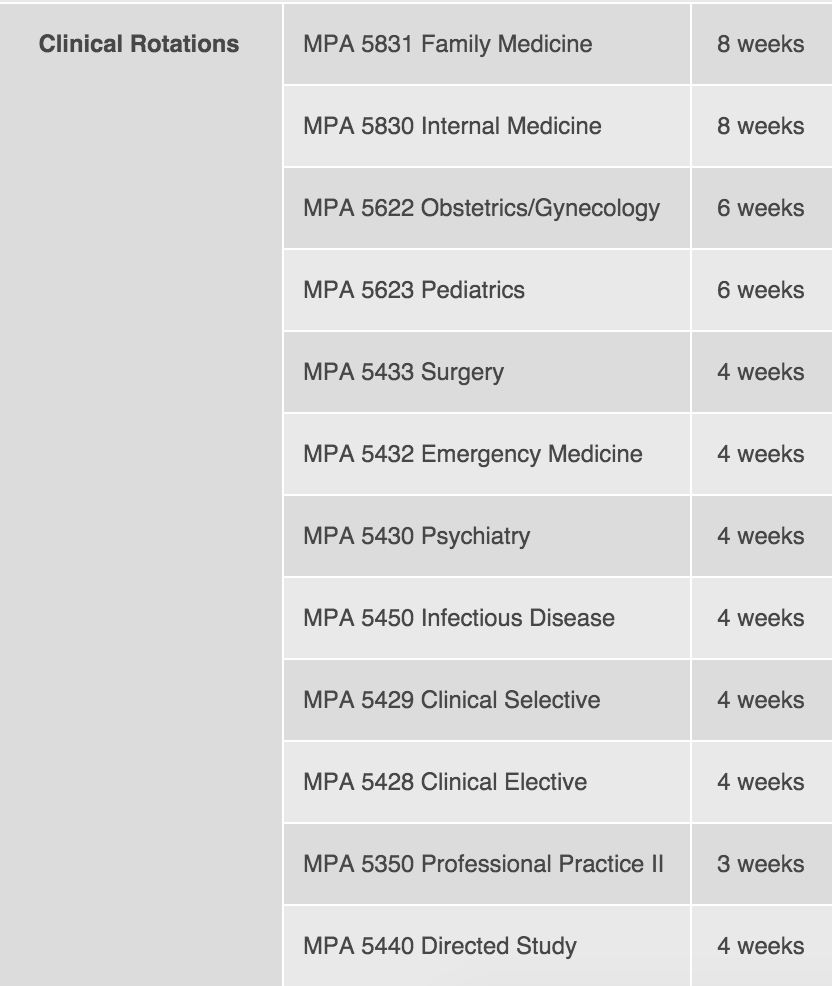
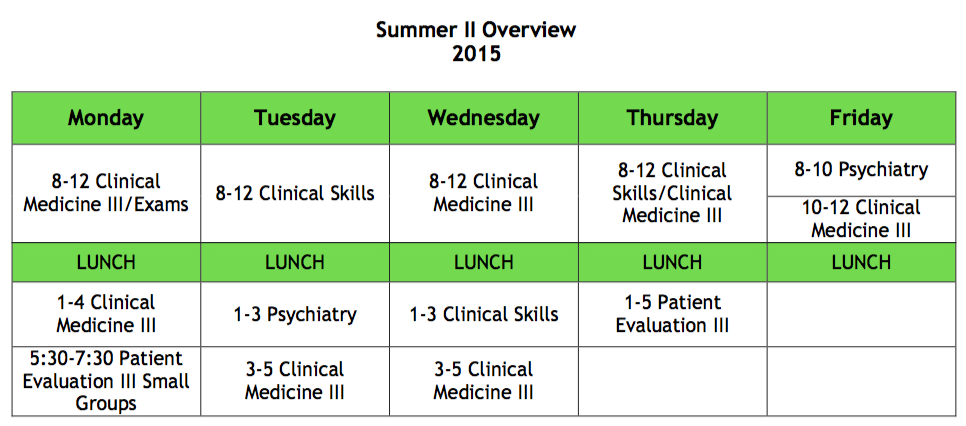
Below is a schedule taken from our program website detailing the clinical rotation schedule. Each student’s rotations are already set up for them (a huge plus), as I learned at the PAEA conference this year that not all PA programs do this. Some programs require that you setup your own rotations. Additionally, I appreciated an increased level of security that our rotations were quality - something not all programs ensure. Our rotations have been vetted before, dropping sites and preceptors who do not meet a high enough standard for our students. Our clinical coordinators have also done a great job of ensuring preceptors provide feedback to our students and that we get the most experience on each rotation, never being left in the shadows.

Screen Shot 2015-12-28 at 7.26.32 PM.png

Sunday, November 1, 2015

The PA School Interview Guide

The PA School Interview Guide
Updated: 10/27/2015

Knowing how to prepare for a PA school interview is as easy as...oh, wait. It’s not at all easy. In fact, easy is probably the last word that comes to mind when you think about your upcoming interview at any PA program. Considering how competitive PA school is and how increasingly competitive acceptance is becoming, you’ll want to read this article to ensure you are fully equipped with the right information before walking through the door.

Numerous PA hopefuls comment on my blog daily, including students who have been offered interviews and are curious about how to prepare; others who have been through interviews and are simply looking for ways to improve. You’ll find the majority of PA school Interview Questions, Essays, and Scenarios on this blog post. The following is an updated guide for the types of questions programs are asking now, topics you’ll need to know, and questions you should be asking.

5 STEPS FOR PA INTERVIEW PREP
  1. The first step to be successful in the PA school interview is to CHECK OUT THE PA SCHOOL INTERVIEW GUIDE - this guide will give you the “in’s and out’s” of each program with information about the interview you will not always find on the program’s sites.

Thursday, August 6, 2015

EENT List of Most Commons for Physician Assistant Students

Most Commons in HEENT for Physician Assistants
HEENT (EENT) makes up 9% of the PANCE and is one of the most common “bread and butter” medicine topics you’ll come across. Below is a combination of “most commons”, “buzzwords”, and other clinical pearls I have come across since completing my didactic year. I compiled this in order to help myself prepare for the PANCE and for rotations. I hope it helps you in your studies as well.
  1. Head
    1. Bell’s Palsy - most common acute disease involving a single nerve and most common cause of acute facial nerve paralysis

Monday, August 3, 2015

Fourth Semester at UT Southwestern

Fourth Semester at UT Southwestern
Updated: 08/03/2015
Screen Shot 2015-07-27 at 8.57.54 PM.png


Finishing didactic is probably one of the most bittersweet and alleviating feelings you have ever felt in your life; there really isn’t another comparison, unless passing the PANCE feels the same way or better. Although this semester may have had a less demanding class-schedule and less courses than previous semesters, there was definitely enough work to be done. Between SOAP write-ups, seeing patients in the hospital or in a controlled (OSCE) setting, or preparing for exams, there was never a dull moment. This semester felt like one of the most rewarding because we finished our didactic education - now it is time to review everything, hammering the material in, and ensuring we are competent providers when we graduate.

Wednesday, July 22, 2015

Pediatrics List of Most Commons for Physician Assistant Students

Most Commons in Pediatrics
  • Most Common Congenital Heart Lesions
    • Left-to-Right Shunts (Breathless)
      • VSD (Ventricular septal defect) - 30%
    • Right-to-Left Shunt (Blue)
    • Common Mixing (Breathless and blue)
      • Atrioventricular septal defect (complete) - 2%
  • Coarctation of the Aorta - most common site is ligamentum arteriosum
    • More common in males than females (3:1)
    • Pathognomonic signs: rib notching on CXR, “three sign” on CTA

Thursday, June 25, 2015

The 80-Hour Resident Work Rule

The 80-Hour Resident Work Rule
In the past, there was conflict with the number of hours medical residents were allowed to work in one week. If you have ever heard of Libby Zion, then you know exactly why that is. She was a patient who died at the age of 18 of serotonin syndrome under the care of what her father considered ‘overworked residents’ and ‘intern physicians’. Because of this, ACGME (the Accreditation Council for Graduate Medical Education) adopted a regulation similar to the Libby Zion Law, also known as the NY State Department of Health Code, Section 405. The regulation put a clinical-hour (‘duty’) maximum on all ‘residents’ of accredited medical training institutions. These ‘duty hours’ are limited to 80 hours per week, averaged over a four-week period, inclusive of all in-house call activities and all moonlighting’ as stated in the ACGME Common Duty Hour Requirements document. The document also states that PGY-1 (postgraduate year-1) residents are currently limited to duty periods of 16-hours duration, while PGY-2 residents are limited to a maximum of 24 hours of continuous duty in the hospital.

20 Phone Apps for Physician Assistants

20 Phone Apps for Physician Assistants
With the immersion and implementation of EMR,  medical phone applications has drastically changed - for the better. As a physician assistant or PA student, you will tasked with “keeping up with the Jones’” in order to monitor the progress of your patients and keep patients interested enough to want to monitor themselves. Products like the Apple Watch and the FitBit have already proven that patients want to monitor their vitals, we just needed a better, easier, and more efficient way for them to do it. I have found the following applications interesting enough to implement into my own practice, but I have not listed any applications for studying here. Instead, these apps offer a variety of services and resources available to you for your patient interaction and monitoring. Take a look at some of them and let me know what you think. If you have found an app that you think is better than some of these listed, let me know in the comments section and I’ll definitely check them out. Thanks for reading!

Tuesday, June 16, 2015

Practicing EKGs for Physician Assistants

Practicing EKGs for Physician Assistants
I get a lot of requests about EKG/ECG courses in preparation for PA school or the PANCE and numerous people searching for EKG courses are re-routed to my blog, so I put a list of them together for your convenience. I hope that pre-PA students, PA-S, and PA-C are all able to utilize these resources and find one convenient, affordable, and suitable to their situation. I’ve tried to list costs and details about some of them, but they’re all very different and some of them are so new they don’t have reviews yet. They range from basic to intermediate and advanced ECG interpretation. Later, I talk about in-person courses and even free resources. There are also books that you can purchase to help you study, which is how I studied EKGs and I found it most helpful to practice strips - lots and lots of them. If you’re feeling ambitious or you work in cardiology, you might consider becoming certified in EKGs, and I provide information about that below as well. Good luck in your studies to becoming a better PA and understanding these rhythms!

Online Physician Assistant Programs

First Online PA Program
By now you’ve surely heard of the first Physician Assistant, excuse me, Physician Associate program wanting to go “live”. What I mean by this is a fully incorporated didactic online program in medicine resulting in the completion of a master's degree without any prior PA training (no certificate, associate’s or bachelor’s degree in PA studies). Yale first announced this news on March 10th, 2015 and while it has had mixed feelings from across the PA and physician community, technology is changing, education is changing, and the realm of the physician assistant must change too. In this article I will brief you on the background of the program and hopefully provide an unbiased approach to online physician assistant programs.


The introduction of Yale School of Medicine's online Physician Associate program has definitely stirred about much debate. Schools like Yale have an outstanding reputation of graduating highly skilled and well-trained physician associates/assistants, but in April of 2015 ARC-PA did approve their initial proposal, as an increase in class size was necessary.

Friday, May 1, 2015

Third Semester at UT Southwestern

Third Semester at UT Southwestern
Screen Shot 2015-05-01 at 1.21.36 PM.png


They say that the further you move along in PA school, the tougher it gets, and “they” are right. In light of the fact that it is only our third semester, this has been the busiest one, for sure. It feels like we had just started the GI block, but before long we had completed neurology, orthopaedics, endocrine, and nephrology/urology. Alas, we received information about our clinical rotations beginning in the fall about 2-3 weeks ago and I am ecstatic. Not only that, but I now have my very own little. If you were unaware, our program has the big/little system. I am able to pass down helpful information and books to my little to help her navigate through PA school.